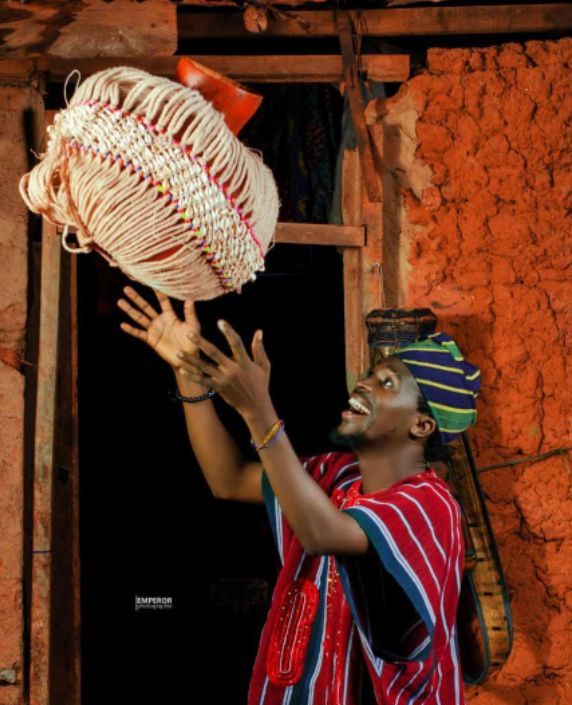
Image 📸| by: Emprorphotographie_ng.
Poem by Ahmad Ọláwálé.
The Song of my Clan


The dusk send my clan's song to the sky
at eventide amidst the mist and battle
of drums, but ¹Tanmohoko is yet to listen
to the song of my clan at dawntime.


my  appraisals and praises
to the brave youths of the time
who have eaten the elders' food
  _ kola nuts, bitter kolas, goat meat, alligator pepper, palm wine;
to fortify their black blood with
strengths of the land owners,
the land owners who molded clay
into shapes and invoked them upon earth.


²Awuru is the most handsome
blessed with nature's pulchritude,
_ his ³adire glows the elegant beauty of a peacock
he drums relentlessly to the spirit song
like a battle drum, beaten to an intense
war between a hunter and a lion
as the hunter prowls to slay the king of the jungle;


⁴Iṣin, my sisters; whose black beauty
is unrivaled, dance rhythmically
to the spirit song followed by the festive drums
_ Dundun, sekere, gangan and omele.
they dance and shake bums non-stop
like the rolling of ball bearing
in a fleeting oscillatory movement;


meanwhile my young brother who
at youthhood, adorn the way of our life
will not allow shame to take away the
cynosure of the moment, he will never
succumb to inferiority;
so he spread his Ofi attire, elegantly
and danced, ferociously
the dangerous dance of Òkòtó
eliminating all that is on its way.


they dance and sing, drunk but sober
from the spirit place of ancestors where
my clan laid her breasts to feed away
the joy of every hungry child and soon
they will join them to sing the song of my clan
which by installment they listened to;

   _ drink, my soul brothers, drink!
we have paid tribute to our elders
woman, bring more wine and let
Àgbè keep wine in abundance for us
we have paid tribute to our elders
Sẹ̀kẹ̀rẹ̀, the embodiment of wealth
go all the way 'round the four corners
of earth and bring the mythical song
of our forefathers
we have desired to sing the song
of wealth and wisdom
who will come and sing with us
we have paid tribute to our elders;


since then they ululate, with mouths,
littered with undiluted blood of palm trees
and surge with joyful songs on their lips
_ the full moon have heard them sing
in their palm tent under her shimmering canopy.


vultures' eyes that burn both the human body and soul
to ashes with a piercing look dare not look
their way since the elders' insight are
inculcated into them, they can now call upon the land owners,
tranquil souls that dominate men upon arrival;


they are now the elders
who by time spend their evening
at the village square embracing
the comfort of their life, with gourds,
full of frothing palm wine and gulping
its essence down their throat like a flood
rushing down a ravine.


In moment like this,
when my clan sing her song
I am no more sure how afraid my people
were
of the mighty Khaki clothed officers
from the England offices.


People look, this is me paying tribute
to the patriarch of my ancestors,
see how meticulous I am at the moment,
melodiously unchanging;


This is how we convivial spirits used to live
when the moon was full and undisturbed;
evening ariya in my clan and the dance
of my blood brothers and sisters;
the love among us, African children
transcended all kinds.
The following words remained untranslated in the poem to depict the strong tradition of the poem.
Tanmohoko : the evening sun.
Àgbè : dried gourd.
Sẹkẹrẹ : the beaded gourd rattle, a traditional musical instrument commonly used in West Africa.
‘Awuru : Dada Awuru is a term commonly used for a natural twisted haired or dreadlock child in Yorubaland. Dada are born with long thick and curly hair which is not to be cut off anytime. Dada are also called Awuru or Olowo ori and are known to be strong and stubborn. Dada, whether male or female, are perceived to be handsome and beautiful by most of the Yorubas.
Adire: Adire textile is an indigo-dyed cloth made in southwestern Nigeria by the Yoruba women using a variety of resist-dyeing techniques. The word “adi” (tie) + “rẹ” (dye) being Adire means tie and dye which is usually applied on materials with wax-resist methods that will produce patterned designs in a dazzling array of tints and hues.
Iṣin: Iṣin, Ackee apple is a fruit whose fleshy part is eaten raw or cooked. Its Raphe (seed, koro isin) is deadly and must be carefully removed before the flesh is consumed. Ackee apple is a native fruit to Jamaica and some parts of west Africa. The word “Iṣin” is taken from the most popular simile ever used by the Yorubas. The word “dudu bi kóró iṣin” (to be black like an Ackee seed) is used to praise the unperturbed beauty of black African women.
Gangan and Omele: Gangan and Omele drums are two sets of traditional musical instruments used for different occasions. Omele Gangan is an African talking drum used (during the precolonial era) to communicate or send messages from one place to another although they’re still in use for traditional occasions.
Ofi: is a traditional hand-woven cloth from the wooden loom.
Òkòtó: is a special toy material locally produced. It is made by putting a broom strand through a particular fruit seed, it can also be made with two bottle covers, rubber bands and a long strong broom strand passing through the bottle covers to roll it. This “Òkòtó” play is common among the Yoruba children and they play to compete whose own can last longer when rolling/playing.
This poem remains in its raw form, unchanged since its first edit in 2023. While I envision future revisions to deepen certain passages, I’m sharing it now as a living document, a snapshot of voice and vision at a particular moment in my creative journey.

 Ewì Áfríkà